July 2011 archive
In Colorado. Pics from the drive:

Rainbow on my neighborhood last night.
Today, I leave for Colorado. I had a wild dream last night, with events so preposterous that
I thought there's no way I can blog about this because no one
will believe it. I asked someone I was with whether he'd
seen what I saw; he said, "Yes, but that doesn't mean it happened."
I had a wild dream last night, with events so preposterous that
I thought there's no way I can blog about this because no one
will believe it. I asked someone I was with whether he'd
seen what I saw; he said, "Yes, but that doesn't mean it happened."
The first year I lived here, I asked a local I'd met what a typical
Lone Pine winter was like--and he said there is no such thing.
There can be a trace of snow or there can be a fair amount.
As to whether or not there's such a thing as a typical Lone Pine summer, either there will be a stretch of smoky days from one or more forest fire[s] in the Sierra Nevada, or there won't. This July--the month I am here for--is featuring smoke from a fire about 50km to the southwest.
As to whether the flora and fauna show typical patterns, that hinges on weather and on who knows what else. 2003 was the year of being inundated by moths in the spring. 2011 is the year of small mammals eating everything in sight. Nevermind the rat that ate my refrigerator cord; critters have completely denuded an incense cedar in my yard. The tree was here in 1997 when I moved in, and I never saw it lose foliage to rabbits or squirrels or what-have-you. It must have gotten tastier all of a sudden. It's decimated. Only the hardest to reach branches have any green left.
That's okay. If you grow stuff in the desert--especially stuff that doesn't grow here on its own--you take what you get.
 Earlier this week, in an auction for a patent portfolio,
Google placed bids of $1,902,160,540, $2,614,972,128, and $3.14159 billion.
Whereas 3.14159 is familiar enough, the first two are obscure. They refer to
Brun's constant and
the Meissel-Mertens
constant; both relate to the distribution of prime numbers.
Earlier this week, in an auction for a patent portfolio,
Google placed bids of $1,902,160,540, $2,614,972,128, and $3.14159 billion.
Whereas 3.14159 is familiar enough, the first two are obscure. They refer to
Brun's constant and
the Meissel-Mertens
constant; both relate to the distribution of prime numbers.
Reuters didn't get it: "It was not clear what strategy Google was employing, whether it wanted to confuse rival bidders, intimidate them, or simply express the irreverence that is part and parcel of its corporate persona." An [unnamed] source was equally clueless: "Either they were supremely confident or they were bored."
Or: some of us are just keen on numbers. Google's culture reflects the mathematical bent of their founders. Google numbers their buildings, and not just with integers but with transcendental and imaginary numbers as well. They proposed a figure of $e billion in their IPO. I would've been more surprised if Google had placed boring round-numbered bids.
But back to the numbers in question. Brun's constant has a fun history: it was in computations that (among other things) estimated Brun's constant that Thomas R. Nicely discovered the infamous Pentium FDIV bug.
Back when math coprocessors were sold in separate packages, Intel ran ads with a pic of a pocket calculator shaped like a clown--to ridicule the idea of buying some "brand X" processor to do math. (I couldn't find an example on the web; if you have one, I'd be grateful for a pic.) Intel didn't run ads like that after some of their Pentiums were found to make errors in floating point division.
The FDIV bug episode rankled people not so much because Intel's products (well, their quotients) were flawed but because of how Intel handled it. Intel knew about the defect before it was in the news but hadn't acknowledged it in an errata sheet. Once it became known, Intel offered to replace defective Pentiums only for users who could demonstrate that their particular applications were affected. Only after it became a PR nightmare did Intel offer replacements with no questions asked. Walking stick on my window screen tonight.
The pic invokes a mild version of this illusion.
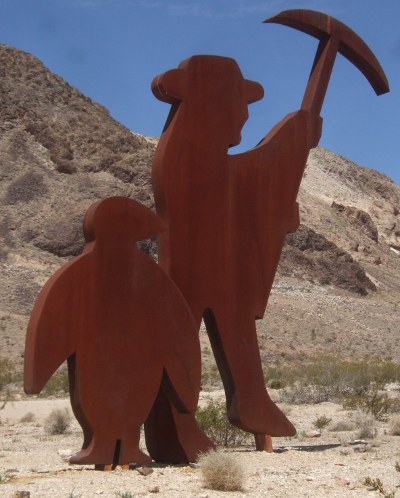
| A sculpture
I blogged about
7.7 years ago. I finally have my own pic of it to post. |
 |
 |
Jackrabbit, near the base of aforementioned sculpture. |
| Aforementioned jackrabbit,
shortly afterwards. |  |
 |
I told you we shoulda bought gas at Venus. |
| For symmetry, because I posted a VORTAC pic from the trip west. This one is MMM, outside Las Vegas. |  |

Rainbow on my neighborhood last night.
Today, I leave for Colorado.
I had a wild dream last night, with events so preposterous that
I thought there's no way I can blog about this because no one
will believe it. I asked someone I was with whether he'd
seen what I saw; he said, "Yes, but that doesn't mean it happened."
| I love when, as happened this afternoon, my travels take me through the Bridgeport Valley. It has this wonderful feeling of spaciousness that I don't think I could photograph. Part of the feeling comes from being presented with its meadowy expanse after a bunch of driving through mountainous terrain. It's also hard for a straight-on photograph to take in the full facade of the Mono County courthouse in Bridgeport, what with the trees in front of it. It must surely be the coolest courthouse in all of California. Or, alternatively: if there is a cooler one, I'm happy not to know about it. |  |
As to whether or not there's such a thing as a typical Lone Pine summer, either there will be a stretch of smoky days from one or more forest fire[s] in the Sierra Nevada, or there won't. This July--the month I am here for--is featuring smoke from a fire about 50km to the southwest.
As to whether the flora and fauna show typical patterns, that hinges on weather and on who knows what else. 2003 was the year of being inundated by moths in the spring. 2011 is the year of small mammals eating everything in sight. Nevermind the rat that ate my refrigerator cord; critters have completely denuded an incense cedar in my yard. The tree was here in 1997 when I moved in, and I never saw it lose foliage to rabbits or squirrels or what-have-you. It must have gotten tastier all of a sudden. It's decimated. Only the hardest to reach branches have any green left.
That's okay. If you grow stuff in the desert--especially stuff that doesn't grow here on its own--you take what you get.
|
A certain jackrabbit seems to have taken up residence on my
lot while I was gone. Perhaps he thinks he was here first,
and saw me as an interloper when I rolled in last week.
In any case, he's used to me now and doesn't run away when
I walk by. During the day he chases the shade around the yard.
A proverb attributed to Lao Tzu: "He who knows does not speak, he who speaks does not know." With how little jackrabbits say, and how big their eyes are, it's easy to imagine them knowing quite a lot. |
Earlier this week, in an auction for a patent portfolio,
Google placed bids of $1,902,160,540, $2,614,972,128, and $3.14159 billion.
Whereas 3.14159 is familiar enough, the first two are obscure. They refer to
Brun's constant and
the Meissel-Mertens
constant; both relate to the distribution of prime numbers.
Reuters didn't get it: "It was not clear what strategy Google was employing, whether it wanted to confuse rival bidders, intimidate them, or simply express the irreverence that is part and parcel of its corporate persona." An [unnamed] source was equally clueless: "Either they were supremely confident or they were bored."
Or: some of us are just keen on numbers. Google's culture reflects the mathematical bent of their founders. Google numbers their buildings, and not just with integers but with transcendental and imaginary numbers as well. They proposed a figure of $e billion in their IPO. I would've been more surprised if Google had placed boring round-numbered bids.
But back to the numbers in question. Brun's constant has a fun history: it was in computations that (among other things) estimated Brun's constant that Thomas R. Nicely discovered the infamous Pentium FDIV bug.
Back when math coprocessors were sold in separate packages, Intel ran ads with a pic of a pocket calculator shaped like a clown--to ridicule the idea of buying some "brand X" processor to do math. (I couldn't find an example on the web; if you have one, I'd be grateful for a pic.) Intel didn't run ads like that after some of their Pentiums were found to make errors in floating point division.
The FDIV bug episode rankled people not so much because Intel's products (well, their quotients) were flawed but because of how Intel handled it. Intel knew about the defect before it was in the news but hadn't acknowledged it in an errata sheet. Once it became known, Intel offered to replace defective Pentiums only for users who could demonstrate that their particular applications were affected. Only after it became a PR nightmare did Intel offer replacements with no questions asked.
 Walking stick on my window screen tonight.
The pic invokes a mild version of this illusion.